
Domestic resource mobilization through increased efficiency: How Liberia’s performance-based contracting mechanism is improving health results
Domestic resource mobilization through increased efficiency: How Liberia’s performance-based contracting mechanism is improving health results
Co-authored by: Rufus Saye, Vera Mussah, Solomon Sagbeh, Jacob Hughes, Sara Wilhelmsen
In recent years, the slow global economic recovery post-COVID highlighted the need for increased efficiency in public spending on healthcare and reinforced the relevance of government health service contracting. The U.S. Government’s efforts to transition non-governmental organization (NGO) contracting for tuberculosis (TB) services to national governments aligned with the fiscal need for increased efficiency and sustainability of government spending on health. This transition became even more urgent when USAID was abruptly closed down and other major donor funding sources for health were significantly cut. Current economic shocks (e.g., global trade wars and the US war with Iran and rising cost of oil) continue to amplify the need for increased efficiency and getting more health for the money. Rufus Saye – Liberia’s National Leprosy and TB Control Program Manager – provided this context on March 31, 2026, during the Joint Learning Network (JLN) Contracting Learning Lab[1]’s second virtual technical session. Liberia shared its experience using domestic resources through performance-based contracting/ financing (PBC/PBF) to improve efficiency and strengthen health results.
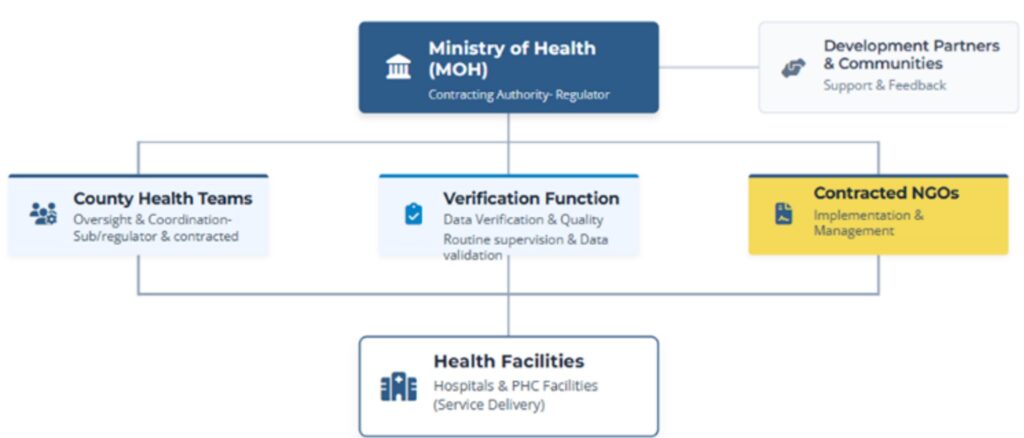
At this session, Vera Mussah, Director of Liberia’s Ministry of Health (MOH) Performance-based Financing Program, described Liberia’s experience with NGO-based service contracting using a PBF/PBC framework. Mussah explained that the model is being used as a contracting mechanism, tying financing to verified results, empowering facilities with financial autonomy and incentives, and reinforcing data use, verification, and accountability. In the immediate post-war period in Liberia, NGOs were contracted to manage health facilities under a contracting-out arrangement. During this period, NGOs played a critical role in strengthening the capacities of County Health Teams (CHTs), which later enabled the transition to a contracting-in model led by local government institutions.
Under the current arrangement, NGOs are no longer directly contracted to manage service delivery. Instead, they provide technical support through independent verification, financial oversight, and capacity building. NGOs engaged in verification functions are also expected to strengthen the capacity of local government institutions to eventually assume these verification responsibilities.
PBC/PBF-based contracting has been shown to strengthen service delivery. The coverage and utilization of maternal and child health services increased in 2024-2025 according to verified data compared to 2023. In the 7 contracted counties (out of Liberia’s 15 total counties): 80% of pregnant women attended4 or more antenatal care visits; 74% of deliveries took place in facilities with a skilled birth attendant; and 67% of the catchment population was fully immunized (Ministry of Health HMIS data, 2025). Health outcomes in the contracted counties were stronger than in the non-contracted counties.
Although the MOH has moved to a new approach by contracting directly to country health teams, the ministry continues to implement PBC/PBF and maintain the oversight responsibility of monitoring, mentoring, and supervision developed during the earlier contracting-out model.
Liberia’s experience offers several lessons for countries exploring similar approaches:
- Align contract design with MOH priorities and Essential Package of Health Services
- Keep indicators focused and verifiable
- Use independent verification to promote trust and strengthen data systems
- Invest in digital data system to improve timely payments and feedback loops
- Engage stakeholders at all levels during design and implementation
- Conduct regular monitoring and supervision to boost staff morale
- Build capacity at all levels and with relevant actors
- Integrate implementation into existing systems and structures to support transition and sustainability
Following Mussah’s presentation, Solomon Sagbeh, Senior Accountant in the MOH’s Office of Financial Management (OFM), discussed Liberia’s efforts to strengthen public financial management (PFM) systems. Sagbeh shared that to improve stewardship and increase confidence in the MOH’s ability to manage donor and domestic funds, the ministry established the Health Sector Pool Fund Office, which later became part of the OFM. Sagbeh described the structure and functions of the OFM as well as highlighted the usefulness of their financial management policy document and a procedures manual. The central MOH trained accountants at the subnational level in the policies and procedures – not only to reduce leakage, but also to improve local government’s ability to be compliant and effectively spend their budgets as well as to improve timeliness and accuracy of financial reporting which enhanced management decision-making at both local and national levels. This was all key to getting the most out of NGO contracting, and later contracting-in to counties and health facilities.
During the JLN Contracting Learning Lab’s summit hosted by the MOH in South Africa (June 1-4, 2026), there will be further opportunity for peer learning and consultation on MOH Liberia’s experience with domestic resource mobilization through increased efficiency using PBC/PBF and strengthened PFM. Liberia looks forward to continued sharing, including sharing of experience and lessons from subcontracting with hospitals and development of a contracting toolkit which are among the interests of the learning lab’s Bangladesh MOH team. Be on the lookout for the next blog on the proceedings and outcomes from the upcoming summit in South Africa.
This piece was authored by:
- Rufus Saye, Program Manager, National Leprosy and TB Control Program, Liberia Ministry of Health;
- Vera Mussah, PBF Director, Liberia Ministry of Health
- Solomon Sagbeh, Senior Accountant, Liberia Ministry of Health
- Jacob Hughes, Independent Consultant, Management Sciences for Health
- Sara Wilhelmsen, Independent Consultant, Management Sciences for Health
Editor’s note: This blog is part of the Joint Learning Network (JLN) Contracting Implementation Learning Lab, a 12-month initiative led by Amref Health Africa, the JLN Network Manager, in partnership with Management Sciences for Health (MSH) and country-level JLN teams in Liberia, South Africa, and Bangladesh. Supported by funding from the Joint Learning Fund (JLF), the learning lab helps countries accelerate government-led contracting for health services through peer learning, technical exchange, and collaborative problem-solving. As Technical Facilitator, MSH supports participating countries to identify and implement practical approaches that strengthen the sustainability and efficiency of essential health programs as donor support declines.
Learn more
[1] This blog describes what this lab and its participants who are representatives from the ministries of health in Bangladesh, Liberia, and South Africa: https://jointlearningnetwork.org/more-health-for-the-money-navigating-the-ins-and-outs-of-contracting-of-health-services-together/